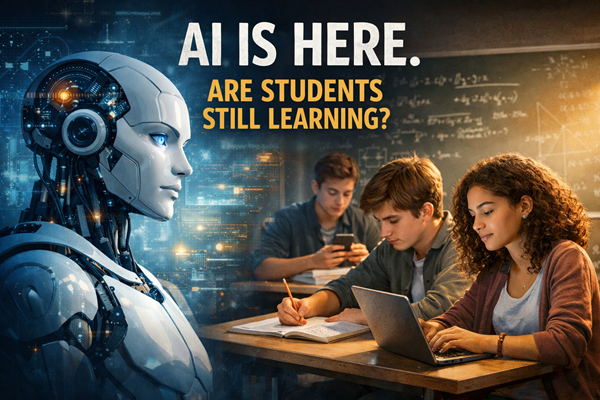
Source: EDUCAUSE | Link: https://events.educause.edu/webinar/2026/ai-is-here-are-students-still-learning
This EDUCAUSE webinar, held in early 2026, explores whether students are genuinely learning more deeply in an era where AI tools are embedded across the learning ecosystem. A panel of academic leaders and learning scientists discuss how generative AI is reshaping students’ study habits, assessment design and expectations of feedback. The session positions AI not just as a productivity layer but as a catalyst forcing institutions to clarify what kinds of learning outcomes they truly value and how they will recognise them.
Key themes include the tension between AI-assisted efficiency and the need for productive struggle, the risk of hollowing out foundational skills, and emerging approaches to designing tasks that require human judgement, reflection and collaboration. The speakers share examples of re-engineered assessments, such as scaffolded projects where AI is permitted in early drafting but restricted in final synthesis, or oral defences that require students to explain and adapt AI-generated work. The webinar also highlights the importance of transparent communication with students about when and how AI may be used, and what constitutes misconduct.
AI-Powered Pedagogy: A Guide to Evidence-Based Teaching Tools
Source: EDUCAUSE Review | Link: https://er.educause.edu/articles/2025/12/ai-powered-pedagogy-a-guide-to-evidence-based-teaching-tools
This resource is valuable for tutors who are rethinking assessment and learning design in light of AI. It can underpin staff discussions about what “learning” should look like in hospitality and tourism subjects where AI tools are increasingly normal, and inspire activities that combine AI use with critical reflection, live explanation and applied problem-solving. It also offers language and framing to help teachers talk with students about responsible AI use while still encouraging experimentation and autonomy.
This EDUCAUSE Review article, published in late 2025, offers a practical guide to using AI-powered tools in ways that are grounded in learning science rather than novelty. It starts from the premise that many AI products promise personalisation and efficiency, but only some align with evidence about how people actually learn. The authors propose a framework for evaluating AI-enhanced tools against outcomes such as retrieval practice, elaboration, timely feedback and metacognition, and emphasise that pedagogy should drive technology choices rather than the other way around.
The article profiles several categories of tools: AI-assisted quizzing that supports spaced retrieval; writing and feedback platforms that scaffold iterative drafting; adaptive tutoring systems; and analytics dashboards that signal where students are struggling. For each, it summarises related research, flags common pitfalls (such as over-automated feedback or opaque recommendation systems) and offers guiding questions educators can use when selecting or implementing tools. A final section discusses governance issues, including data privacy and the need for institutional support for experimentation and evaluation.
For teaching teams, this piece can serve as a shared reference when deciding which AI tools to embed in hospitality and tourism teaching. Tutors might use its questions to audit current platforms, or to shape small-scale trials where the focus is on a specific learning challenge (for example, formative feedback on writing or quantitative reasoning). It can also inform staff conversations about setting expectations with students, co-designing AI use in activities, and documenting how technology choices link to evidence-based teaching principles.
What We Learned from 400+ Interactive Oral Assessments in STEM
Source: Teaching@Sydney | Link: What we learned from 400+ Interactive Oral Assessments in STEM – Teaching@Sydney
This Teaching@Sydney article reports on a large-scale implementation of interactive oral assessments across more than 400 instances in STEM subjects. It synthesises evidence from student surveys, staff reflections and performance data to argue that interactive orals can deepen understanding, reduce opportunities for academic misconduct and strengthen students’ communication skills. The piece is grounded in the Australian context but offers insights that are transferable across disciplines.
The article describes how interactive orals were structured: short, structured conversations between teacher and student (or small groups), often linked to prior written or practical work. It reports that students perceived these assessments as authentic, challenging and fair, with many commenting that they “had to really know” the material rather than relying on surface memorisation. Staff noted benefits for identifying misconceptions in real time and for building rapport, but also highlighted workload and scheduling challenges. The piece provides practical advice on rubrics, question design, moderation and supporting anxious students.
For hospitality and tourism educators, this resource can inspire more dialogic assessment formats, such as menu-design or revenue-management orals, scenario debriefs or brief viva-style conversations around group projects. It can underpin tutor development sessions on questioning techniques, criteria for assessing explanation and applied reasoning, and strategies to manage time and consistency. Sharing selected student quotes and design tips with teaching teams can help normalise experimentation with interactive orals as one response to AI-driven challenges in written assessment.
The Skills Revolution: The Time Has Come for a Counter-Revolution
Source: HEPI (Higher Education Policy Institute) | Link: https://www.hepi.ac.uk/2026/01/19/the-skills-revolution-the-time-has-come-for-a-counter-revolution/
In this January 2026 HEPI blog, David Goodhart argues that the current “skills revolution” narrative in higher education has gone too far, privileging short-term, employer-driven skills at the expense of broader knowledge, critical thinking and citizenship. He contends that an excessive focus on skills training risks narrowing the purpose of universities and may leave graduates less adaptable in the face of technological and labour-market change. The piece calls for a “counter-revolution” that re-balances skills with deeper forms of learning.
The blog critiques policy and funding frameworks that incentivise narrowly vocational outcomes, and questions metrics that treat graduate employment and earnings as the primary markers of success. It points to the enduring value of disciplines and knowledge traditions, arguing that they provide the context in which skills are developed and applied. Goodhart suggests that while digital and AI-related skills are important, they should be nested within a wider educational project that includes ethics, cultural understanding and the capacity to question assumptions.
This piece can help teaching teams in hospitality and tourism situate employability conversations within a more holistic educational philosophy. Tutors might use it in staff discussions about learning outcomes, asking how to integrate applied skills with disciplinary perspectives on tourism, hospitality and events. It can also inform classroom activities in which students debate the balance between skills and knowledge in their own degrees, or reflect on how AI-driven changes in the industry heighten the need for critical judgment, ethical awareness, and a sense of purpose beyond immediate job roles.